Technical Articles, Case Studies and White Papers (Relating to level measurement, solids
flow monitoring, particle emission detection, bin aeration
applications and more)
Advanced
Material Flow/No-Flow Detection Using Point Level Sensors,
Microwave Flow Detectors >>
Click to download article
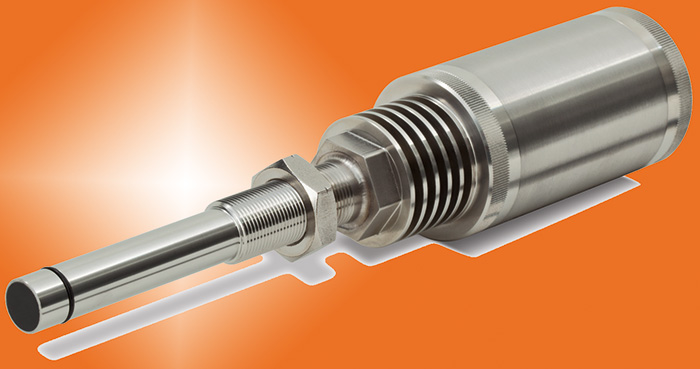
The QuantiMass in-line mass flow sensor measures the flow of quantities in pneumatic conveying & free-falling processes. The sensor is based on the latest Microwave Doppler Effect technology and provides fast, in-line / on-line measuring without the use of weight scales.
The sturdy, non-intrusive design of the sensor minimizes maintenance. In addition, the compact size of the sensor makes for easy installation into existing processes. Suitable for powders, dust, pellets, and granular up to 0.75 inch (2cm).
Versions:
Ultra Series-Includes controller
PRO Series-Includes transmitter
A practical application for the QuantiMass would be to monitor material flow rates to verify blending mixture ratios.
Principle of Operation:
The QuantiMass Mass Flow Measurement Sensor / Meter is designed with the latest microwave technology and is used to continuously quantify the flow of powders & solids being conveyed in metallic pipes. The QuantiMass is based on technology that has been developed and proven over several years. The measurement process of the sensor is centered on the Doppler effect. The mass flow-rate is determined by evaluating the frequency and amplitude changes during the measurement process. Particles at rest, such as deposits, do not influence the measurement. All powders, dust, pellets and granules can be measured reproducibly, up to the size of 0.75 inch (2cm). The QuantiMass sensor is suitable for continuous in-line / on-line measurements in pneumatic conveying or in free-fall pipelines.


 Mobile
View
Mobile
View