ABOUT US
|
|
|
|
|
|
|
History of Monitor Technologies
Monitor Technologies LLC was founded by George Gruber in Port
Sanilac, MI in 1958. The company was then known as Sanilac Manufacturing
Company and had a product line consisting of two (2) rotary paddle
units, the Model M and MX. In 1960, Mr. Gruber moved the company
to Minden City, MI and adopted the name Monitor Manufacturing. This
name would define the company for the next 38 years.
By 1965, Monitor’s
product line consisted of three (3) rotary paddle units and one
(1) model of a diaphragm switch unit. Over the
years the product line grew and by 1980 consisted of twenty-two (22)
products used almost exclusively for the level detection of powder
and bulk solids materials. Our customer base grew from approximately
130 accounts in the early 1960’s to over 10,000 worldwide.
Since
1980, other products have been added through acquisition and internal
development. In 1965, Monitor was acquired by D K Manufacturing.
Monitor’s sales offices moved to D K’s location in
Batavia, IL while the manufacturing operations remained behind
in Michigan.
Several years later in 1972 D K Manufacturing, including Monitor,
was acquired by CRL. In 1977, Monitor had outgrown both the Batavia
and
Minden City locations and the entire Monitor Manufacturing operation
was consolidated in a new facility built in Elburn, IL where we
are located today.
Monitor’s product line continued to expand.
RF Capacitance and Vibratory technologies were added to its existing
mechanical and electromechanical
product lines for point level monitoring. The company’s weight & cable
inventory monitor was developed and became an industry standard.
Some product lines that didn’t fit Monitor’s focus
on instrumentation for powder and bulk solids were sold off in
the early 1990’s,
and the Company went through a management buyout and changed its
name to Monitor Technologies LLC in April of 1998.
In the late
1990’s and into the first decade of the new millennium
new technologies were added through development, such as our SiloPatrol® smart
weight & cable inventory monitoring system and SiloTrack™ PC-based
inventory management software. Other new products were brought
to the market during this time frame through strategic partnerships.
Monitor’s
focus on quality was first exemplified in 2000 when it achieved
certification to ISO 9001 standards.
Monitor’s current focus
remains that of instrumentation for powder and bulk solids applications.
Monitor is
committed to be second-to-none in delivering the highest degree
of customer satisfaction delivered through every contact our customers
have with us. We will not accept anything less. Our customer
service team is dedicated to this end.
Today, Monitor Technologies LLC
offers superior solutions in level monitoring, solids flow detection,
moisture measurement, particle emission monitoring
and bin aeration. Give us a call today and let us put our creative
solutions
to work for you!
|
|
|
 |
|
 |
|
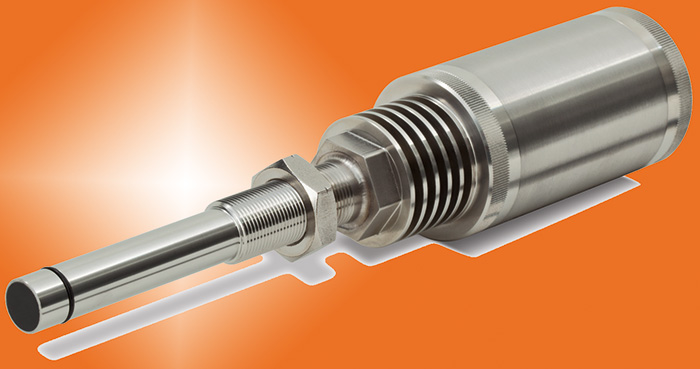
QuantiMassTM
Mass Flow Measurement Systems |
The QuantiMass in-line mass flow sensor measures the flow of quantities in pneumatic conveying & free-falling processes. The sensor is based on the latest Microwave Doppler Effect technology and provides fast, in-line / on-line measuring without the use of weight scales.
The sturdy, non-intrusive design of the sensor minimizes maintenance. In addition, the compact size of the sensor makes for easy installation into existing processes. Suitable for powders, dust, pellets, and granular up to 0.75 inch (2cm).
Versions:
Ultra Series-Includes controller
PRO Series-Includes transmitter
A practical application for the QuantiMass would be to monitor material flow rates to verify blending mixture ratios.
Principle of Operation:
The QuantiMass Mass Flow Measurement Sensor / Meter is designed with the latest microwave technology and is used to continuously quantify the flow of powders & solids being conveyed in metallic pipes. The QuantiMass is based on technology that has been developed and proven over several years. The measurement process of the sensor is centered on the Doppler effect. The mass flow-rate is determined by evaluating the frequency and amplitude changes during the measurement process. Particles at rest, such as deposits, do not influence the measurement. All powders, dust, pellets and granules can be measured reproducibly, up to the size of 0.75 inch (2cm). The QuantiMass sensor is suitable for continuous in-line / on-line measurements in pneumatic conveying or in free-fall pipelines.
Click
here for more information on the QuantiMass
or
contact Monitor Technologies LLC at
Tel.: 800-601-6319 in the USA and
Tel.: 630-365-9403
worldwide.
|
 |
|
|
|
|
|
|
|
 |
|
 |
 |
|