Flexar® Guided Wave Radar
Solves Level Measurement Problems With Flyash
Elburn, IL– Flyash and cement powder can
be difficult materials to measure within silos. The
primary reason is the heavy amount of dust during filling.
Measuring the level of these materials in their storage
silos is important to cement production and users of
cement such as concrete producers who use flyash as
an additive to concrete to improve the end product
quality. Level measurement and monitoring in these
silos is important. Many standard bin level indicators
and ultrasonic and through-air devices will not work
reliably. For this reason, flyash processors, utilities
that produce flyash, concrete producers and cement
producers have all turned to guided wave radar and
the Flexar® brand guided wave radar to measure
the continuous changing level of flyash and cement
powder in their storage silos. The success of Flexar
guided wave radar in these applications has added to
the proven nature of Flexar to continuously measure
the level of dusty powders, even during filling.
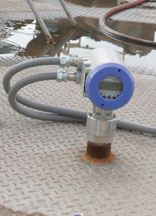
The Flexar® guided wave radar continuous level
sensor uses TDR (time domain reflectometry) technology
to continuously measure the level of a wide range of
powders, granular and liquid materials. A continuous
series of radar pulses is emitted and guided to the
material surface by the heavy duty stainless stell
cable probe. When the radar pulses reach the material
surface they are reflected because of the change in
dielectric constant. The time$#45of$#45flight of theses
radar pulses is measured and directly related to the
distance measured.
Flexar® continuous level sensors can provide
RS485 digital communications output or 4-20mA
output. The RS485 can be connected to Monitor's
SiloTrack™ inventory management system. The Flexar
unit can be powered by 115VAC, 230VAC or 24VDC.
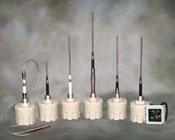
The TrueCap® Model MK-2
RF Capacitance point level probe is designed to provide a superior
and stable sensitivity threshold making it suitable for a variety
of powder / bulk solids and some liquid or slurry applications.
Advanced features of the Model MK-2 include: > Automatic immunity to material build-up on
the probe by its driven shield design > Push-button calibration > Enhanced temperature compensation > Maximized reliability via smart sensing algorithms
like “self-validating” fail-safe protection > Visible status LED on ordinary location units > Versatility through a variety of configuration
options including: hazardous location version, split architecture
design, quick-connect process connection, stub probe, cable extensions,
solid extensions, Nylon® probes, Ryton® - equiv. probes,
etc.
A practical application for the TrueCap would be to use this level sensor where
a residual material build-up on a different sensor would cause a false material
level indication.
Principle of Operation for the TrueCap RF Capacitance Level
Probe:
The vessel wall and the active probe element establish an impedance reference
between each other when exposed to air which has a dielectric constant of 1.
When materials with a dielectric constant greater than 1 are in close proximity
to the probe, the impedance of the sensing field between the sensor and the vessel
wall will change. Once the amount of change exceeds a threshold that was electronically
determined during the calibration process, an output relay will either be energized
or de-energized depending upon the position of the fail-safe selector on the
probe’s electronic circuit board. A change of as little as .5 pico-farad
is all that is necessary for the probe to sense the presence of material.