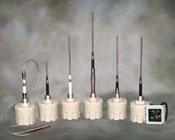
Flexar® Continuous Level Systems Successful on Cement Powder
and Flyash at Batavia Concrete
SITUATION:
“I have no idea how much material we have left in our cement
and flyash bins. We need a reliable solution to make us more
efficient.”
EXPLANATION:
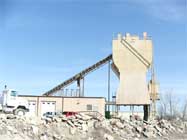
Batavia Concrete is located in Montgomery, IL and is one of many
concrete batch plants operated by Prairie Materials in northern Illinois. Like
most concrete plants, Batavia uses cement and flyash as ingredients. Ready
mixed concrete batch plants take the basic components needed to form
concrete, i.e. sand, rock, cement powder and flyash and batch them
together for loadout into concrete trucks. Concrete is used
as a versatile construction material and there are literally tens
of thousands of batch plants around North America.
Unfortunately,
Batavia’s facility only used high and low level indicators. Their
operations manager, Fred Thompson, had no idea how much material was
remaining at any given time. This delayed replenishment and sometimes
they couldn’t fit a truckload of cement or flyash into the bin. They
needed to know the level of the material at any given time in order
to become more efficient.
SOLUTION:
Chief application engineer for Monitor Technologies, Andy Bowman,
decided to employ the Flexar technology and product to help Batavia
Concrete. Monitor Technologies introduced the Flexar® guided
wave radar continuous level measurement system to Batavia Concrete
in December 2005. Monitor strategically acquired this level
sensing system during 2005 to add to its significant solution capability
for powder and bulk solids applications. Flexar is proven
technology combined with five decades of bulk solids experience
and unique inventory management software solutions. Monitor
knew it had the right solution for Batavia Concrete.
Flexar is a guided wave radar continuous level sensor. Distance/level
is measured by the time-of-flight of the reflection of a microwave
signal (transmitted down the wave-guide, which is a heavy-duty
0.3” SS cable with 3.9 ton tensile strength) off the material
surface. Cement and flyash both have relatively low dielectric
constants and Flexar’s direct measuring mode was successful
in providing real-time continuous updates of the material level
during filling and draw-down.
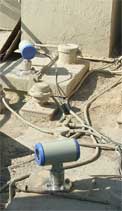
Both Flexar units are installed with 34’ cable length. The
4-20mA signal from each Flexar unit is connected to a panel meter
in the control room. Fred Thompson, Regional Operations Manager
of Batavia Concrete, has been satisfied with this solution ever
since it was installed. Observations during filling cycles
were very good right off. Flexar didn’t skip a beat,
even with the heavy dust kicked up during pneumatic filling.
Fred Thompson reports that he desires to install Flexar units
at other plants within his regional area of responsibility. He
prefers the true continuous nature of Flexar guided wave radar
units.
Give Monitor Technologies a call and let us put our creative solutions
to work for you!
The TrueCap® Model MK-2
RF Capacitance point level probe is designed to provide a superior
and stable sensitivity threshold making it suitable for a variety
of powder / bulk solids and some liquid or slurry applications.
Advanced features of the Model MK-2 include: > Automatic immunity to material build-up on
the probe by its driven shield design > Push-button calibration > Enhanced temperature compensation > Maximized reliability via smart sensing algorithms
like “self-validating” fail-safe protection > Visible status LED on ordinary location units > Versatility through a variety of configuration
options including: hazardous location version, split architecture
design, quick-connect process connection, stub probe, cable extensions,
solid extensions, Nylon® probes, Ryton® - equiv. probes,
etc.
A practical application for the TrueCap would be to use this level sensor where
a residual material build-up on a different sensor would cause a false material
level indication.
Principle of Operation for the TrueCap RF Capacitance Level
Probe:
The vessel wall and the active probe element establish an impedance reference
between each other when exposed to air which has a dielectric constant of 1.
When materials with a dielectric constant greater than 1 are in close proximity
to the probe, the impedance of the sensing field between the sensor and the vessel
wall will change. Once the amount of change exceeds a threshold that was electronically
determined during the calibration process, an output relay will either be energized
or de-energized depending upon the position of the fail-safe selector on the
probe’s electronic circuit board. A change of as little as .5 pico-farad
is all that is necessary for the probe to sense the presence of material.










 SITUATION:
 Unfortunately,
Batavia’s facility only used high and low level indicators. Their
operations manager, Fred Thompson, had no idea how much material was
remaining at any given time. This delayed replenishment and sometimes
they couldn’t fit a truckload of cement or flyash into the bin. They
needed to know the level of the material at any given time in order
to become more efficient.
Unfortunately,
Batavia’s facility only used high and low level indicators. Their
operations manager, Fred Thompson, had no idea how much material was
remaining at any given time. This delayed replenishment and sometimes
they couldn’t fit a truckload of cement or flyash into the bin. They
needed to know the level of the material at any given time in order
to become more efficient.