Self-Validating High Level Indicator Saves $Thousands in Costs
Elburn,
IL – When your high level sensor fails, when do you find out? If you’re like most people you find out when you overfill your bin or silo. Then you have to deal with the aftermath, which means cleanup costs, lost product, contaminated product, damaged equipment, maintenance and your boss breathing down your neck to get the production back up and running. One user of high level sensors tells that he estimates the cost of overfilling a silo to be about $5,000.
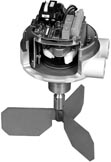
Today a new class of high level sensor has emerged, sensors that are “self validating” and not just simply fail-safe on power failure. The SafePoint® is the leader in self-validating high level sensors and provides "True" fail-safe protection. We are pleased to announce the issuance of a patent by the United States Patent Office that covers the use of Hall-Effect sensors as an integral component to ensure reliability of the self-validating techniques contained within the SafePoint bin level indicator. The SafePoint is the only device to use this reliable and safe technique to allow the instrument to self-validate its function to ensure safe process operation. While other devices use optical sensors that can be fouled with dust and other contamination, the use of magnetic Hall-effect sensing technology ensures full-time reliable self-validation and operation. The cost to prevent spills due to unrecognized high level sensor failure? About $300 for ordinary locations. Why use anything else?
The SafePoint bin level indicator's self-validating and patented technology continuously monitors its internal functionality and indicates its safe state to the user of the device. If through damage, electrical/mechanical failure or component malfunction the sensor is unable to operate properly, an output is immediately initiated to indicate a failed condition. This sensor health status indication is in addition to the standard output function indicating the presence / absence of material in the vessel at the point desired to be monitored. Local indication of sensor health and material presence/absence is also provided in all ordinary location units.
SafePoint bin level indicators are the best choice for safely indicating the level of powder and other bulk solids in bins, silos and tanks. Unlike other brands and devices available, the SafePoint reliably protects the user against overfilling and surprise outages using patented Hall-effect sensors.
For more information refer to www.monitortech.com/product_p_fails.shtml or contact Ms. Emily Jones of Monitor Technologies at 1-800-766-6486 (630-365-9403).
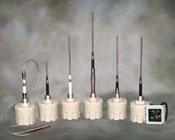
The TrueCap® Model MK-2
RF Capacitance point level probe is designed to provide a superior
and stable sensitivity threshold making it suitable for a variety
of powder / bulk solids and some liquid or slurry applications.
Advanced features of the Model MK-2 include: > Automatic immunity to material build-up on
the probe by its driven shield design > Push-button calibration > Enhanced temperature compensation > Maximized reliability via smart sensing algorithms
like “self-validating” fail-safe protection > Visible status LED on ordinary location units > Versatility through a variety of configuration
options including: hazardous location version, split architecture
design, quick-connect process connection, stub probe, cable extensions,
solid extensions, Nylon® probes, Ryton® - equiv. probes,
etc.
A practical application for the TrueCap would be to use this level sensor where
a residual material build-up on a different sensor would cause a false material
level indication.
Principle of Operation for the TrueCap RF Capacitance Level
Probe:
The vessel wall and the active probe element establish an impedance reference
between each other when exposed to air which has a dielectric constant of 1.
When materials with a dielectric constant greater than 1 are in close proximity
to the probe, the impedance of the sensing field between the sensor and the vessel
wall will change. Once the amount of change exceeds a threshold that was electronically
determined during the calibration process, an output relay will either be energized
or de-energized depending upon the position of the fail-safe selector on the
probe’s electronic circuit board. A change of as little as .5 pico-farad
is all that is necessary for the probe to sense the presence of material.