Level Detection...Challenges Sensing Lightweight Polystyrene
Flake Regrind in a Blending Hopper
SITUATION:
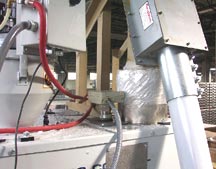
A South Chicago Heights, IL manufacturer of portion packaging,
primarily for dairy creamers, has had much difficulty sensing the
high level in their blending hopper. The hopper contains polystyrene
flake regrind that is very lightweight. They have not had success
using proximity switches due to the low dielectric constant of the
material and dust build-up. What can be used for point level monitoring
with very light materials and in an environment where some dust also
exists?
EXPLANATION:
Materials too light for rotary paddle units (paddle
may just turn and carve a hole in the material) and too light and
dusty for proximity switches are usually problematic. Even capacitance
probes with high sensitivity, such as the TrueCap® family from
Monitor Technologies, may not be successful. Lightweight materials
usually have very low dielectric constants, close to that of air,
making sensing by RF capacitance methods difficult if not impractical.
What will work on lightweight materials less than 5 or even 3lbs/ft³?
SOLUTION:
Many plastic processors have this problem. Those that work
with very lightweight materials, even dust, and any “flake” or “regrind” definitely
can have this challenge. However, vibratory point level sensors
with a single probe design (not tuning forks) tend to work very
well
in these applications, unless there is the possibility of very
heavy
build-ups but this isn’t very likely with very light materials.
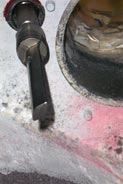
In this example the customer solved their problem of sensing polystyrene
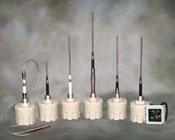
flake regrind by using the Model PZP vibratory point level sensor
from Monitor Technologies.
The Model PZP uses state-of-the-art piezoelectric and electronic
technologies to provide the ability to sense materials as light
as 1.5lbs/ft³. The PZP also provides a relay output and is equipped
with a universal power supply for AC or DC operation.
The PZP is a proven problem solver even for difficult challenges
like very lightweight materials. The PZP is available in a wide
range of probe configurations.
Give Monitor Technologies a call
and let us put our creative solutions to work for you!
Spotlight: RF Capacitance Level Sensor
TrueCap® MK-2
Advanced RF Capacitance Level Probe
The TrueCap® Model MK-2
RF Capacitance point level probe is designed to provide a superior
and stable sensitivity threshold making it suitable for a variety
of powder / bulk solids and some liquid or slurry applications.
Advanced features of the Model MK-2 include: > Automatic immunity to material build-up on
the probe by its driven shield design > Push-button calibration > Enhanced temperature compensation > Maximized reliability via smart sensing algorithms
like “self-validating” fail-safe protection > Visible status LED on ordinary location units > Versatility through a variety of configuration
options including: hazardous location version, split architecture
design, quick-connect process connection, stub probe, cable extensions,
solid extensions, Nylon® probes, Ryton® - equiv. probes,
etc.
A practical application for the TrueCap would be to use this level sensor where
a residual material build-up on a different sensor would cause a false material
level indication.
Principle of Operation for the TrueCap RF Capacitance Level
Probe:
The vessel wall and the active probe element establish an impedance reference
between each other when exposed to air which has a dielectric constant of 1.
When materials with a dielectric constant greater than 1 are in close proximity
to the probe, the impedance of the sensing field between the sensor and the vessel
wall will change. Once the amount of change exceeds a threshold that was electronically
determined during the calibration process, an output relay will either be energized
or de-energized depending upon the position of the fail-safe selector on the
probe’s electronic circuit board. A change of as little as .5 pico-farad
is all that is necessary for the probe to sense the presence of material.










 SITUATION:
 SOLUTION: