SOLUTIONS

REVIEW MY APPLICATION
PLASTIC PROCESSING
FOOD PROCESSING
FEED PROCESSING
GRAIN PROCESSING • • >

AGREGATES
GENERAL / MISC. / OTHER


( click here )

 
Flexar® Continuous Level Systems Used For Critical Level Control in Seed Treating System

PROBLEM:
The level of seed in treater bins needs to be monitored closely to help control the filling and discharging so that a continuous treating operation can be implemented.  A level sensor is needed that will detect and measure the level of the seed accurately, quickly and reliably.

EXPLANATION:
As a leading supplier of seed says, “Seeds carry crops' genetic potential.......... they also carry substantial amounts of energy, which makes them highly attractive for pests and diseases.  Seed treatments are chemical or biological substances or physical processes applied to seeds or seedlings........... to protect the seeds and assure optimum emergence of the crop. Application of a chemical to seeds is a ........... method of reducing pests and diseases' attacks on the growing plant.”

SOLUTION:
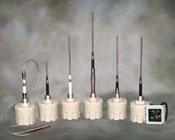
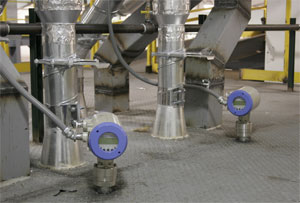
Bins in a seed treatment system may not be very large.  In this specific application the largest measuring range needed was 15.75’ (4.8m) and the shortest measuring range was 5.25’ (1.6m).  With measurement accuracy to 0.8” (20mm) and measurement technology that works at the speed of light, guided wave radar proved to be the best solution.  This seed treatment operation utilizes a total of fifteen (15) Flexar® guided wave radar continuous level sensors.  These instruments use TDR (time domain reflectometry) technology.  The distance/level of the seed is measured by the time-of-flight of the reflection of a microwave signal (1Ghz), transmitted down the wave-guide at the speed of light, off the material surface.  The sensor cable probe is a heavy-duty 0.3” (8mm) diameter stainless steel cable.  The seed in this application is corn and has a bulk density of about 45 lbs/ft3 and a dielectric constant of about 5.0.

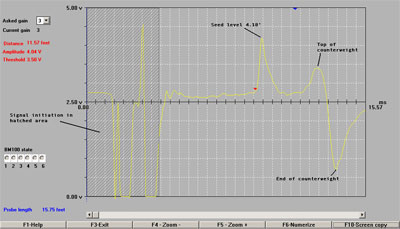
The signal from the Flexar level sensors indicates the seed dielectric was actually about 3.5.  The signal diagram indicates the measurement reflection as well as the reflection from the top and bottom of the counterweight.  The time lag from the material level to the counterweight was due to the material presence.

This was an excellent application for guided wave radar technology and the units are functioning to specification.

Give Monitor Technologies a call and let us put our creative solutions to work for you!


Related Product Solutions
 

>>

Continuously Measuring Corn Surge Hopper Level


Solids Flow Monitor - SFI  
Why Use Solids Flow Monitors?
Assist in detecting problems & increasing automation

From complex automated systems with pneumatic lines to straight-forward gravity chutes, solids flow monitors can help to improve process performance. They are effective in detecting flow problems, as well as enhancing the level of automation at a facility. Solids flow monitors can assist in detecting problems in flow caused by equipment failures, plugged lines, leaks, material bridges upstream, low or no material, etc. They can also be used to add automation to a process like opening or closing valves, turning a conveyor on or off, and initiating a process function (spraying of a product
additive).

The Model SFI and SFD-2 line of solids flow detectors from Monitor Technologies, LLC provide analog or relay outputs to indicate the flow / no-flow condition of powder and bulk solids materials in chutes and pneumatic conveying lines. Using microwave Doppler radar technology these units are non-invasive and extremely reliable and rugged to withstand the rigors of the installation and your process extremes. Since there are no moving parts, these monitors can provide dependable, low-maintenance service for many years.

Solids flow detectors like the Model SFI and SFD-2 can be used in applications for a
variety of industries including construction materials (cement, sand, gypsum, etc.), wood chips / sawdust, feed mills & grain processing, consumer foods (cereal, coffee, sugar, cocoa, powdered milk, barley), plastics, chemicals & pesticides, pharmaceuticals, and more.

One customer uses the analog signal from a Model SFI unit to monitor the flow of carbon black in toner cartridge manufacturing to ensure positive flow before further processing and to detect no-flow and possible plugged conditions. Another company uses the Model SFD-2 solids flow detector to monitor the flow of coal into the burner of a coal-fired power plant to detect no-flow conditions and ensure safety.

Whether a solids flow monitor is used to detect problems, increase automation or both,
the end result is a substantial long term cost
savings through: eliminating product waste,
cutting “downtime”, reducing employee time spent on watching the processes or cleaning up spills/messes, increasing product quality (reducing defective product), and decreasing maintenance time / replacement costs on other methods of flow detection.


>>Click here for more information about Solids Flow Sensors from Monitor Technologies.
>>Download Product Bulletin 813A


Join Monitor's E-Mailing List!
Enter your Email Address Here:


CLICK HERE TO SEND PAGE TO A FRIEND

HOME | PRODUCTS | ASK US | REP LOCATOR | INDUSTRY LINKS | SHOWCASE | ABOUT US
SITE MAP | PRIVACY STATEMENT

© 2005 MONITOR TECHNOLOGIES, LLC. ALL RIGHTS RESERVED

800.601.6302

Free TranslationsFree web translationsWorldlingo.com Translate this page