SOLUTIONS

REVIEW MY APPLICATION
PLASTIC PROCESSING
FOOD PROCESSING
FEED PROCESSING
GRAIN PROCESSING
AGREGATES • • >

GENERAL / MISC. / OTHER


( click here )

 
Proper Tether Length Makes a Tilt Switch Work Better

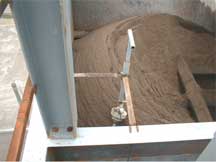
Tilt Switch installation before being corrected. This picture shows improper assembly to rigid pipe. Switch cannot freely swing to 17-degree tilt angle in the direction material will move it.

PROBLEM:
“When my material moves the tilt switch the switch does not give me the output to turn off my conveyor”

EXPLANATION:
Using a tilt switch installed on the underside of a belt conveyor in a sand & gravel facility is a typical application for this type of point level switch. As the pile of sand/gravel or any other material builds up under the conveyor, the pile eventually comes in contact with the tilt switch. When the switch is tilted to 17 degrees out of vertical, the state of the internal switch changes. The distance underneath the conveyor is usually several feet, but this can be set to suit your specific desire.

SOLUTION:
This problem is usually the result of the flexible tether chain or cable that is used to suspend the tilt switch from the conveyor being too long. When using a long flexible tether, the tilt switch will move slightly when the sand/gravel comes into contact with the sensor and then the sand/gravel will surround or “flood” the sensor burying it in the pile before the tilt angle of the tilt switch exceeds 17 degrees. The solution to this problem is to shorten the tether length so the tilt angle is reached sooner. One way to accomplish this and still maintain the desired distance underneath the conveyor is to use a rigid pipe or angle iron attached to a short flexible tether length of about one foot.

Give Monitor Technologies a call and let us put our creative solutions to work for you!


Related Product Solutions
 

>>

Economical High Level Sensing in Grain Storage Bins


Flexar® GWR  
Global Flour Processor Uses Flexar® Guided Wave Radar

A large global flour processor and food products company recently began using the Flexar® guided wave radar in a total of eighteen (18) silos and bins to manage their finished product inventory.  Readings from these continuous level sensors is reported as being reliable and accurate, even during pneumatic filling, contrary to their previous measuring system.  A previous non-performing ultrasonic system was replaced by the Flexar level sensors.  Flexar guided wave radar level sensors were chosen as the best for pneumatically filled dust laden flour silos.

Eight (8) Flexar level sensors are installed in load-out silos that fill bulk trucks with processed and finished flour.  These silos are 12ft in diameter and 35ft tall.  The finished flour is pneumatically conveyed into these silos.  During filling the internal environment of the silos is very dusty and turbulent.  The finished flour in these silos is used for loading bulk transport trucks for distribution.  In addition, ten (10) Flexar level sensors are installed in 40ft high bins that contain bran.  This material is also sent by bulk transport to end users.

All of the Flexar level sensors are equipped with an RS485 digital communications output that is connected to a PC with a graphical user interface for inventory management purposes.  Monitor’s SiloTrack™ inventory management software is used by the facility to monitor and manage material inventories of both the finished flour and the bran.  SiloTrack allows for multiple user viewing and data access via LAN and this is how the facility will be using the software that provides a flexible, graphical user interface, alarms, report generation and history analysis functions.

Guided wave radar is especially well suited to level measurement applications of dusty powder materials even when measuring during pneumatic filling.  Flexar guided wave radar utilizes TDR (time domain reflectometry) technology.  Radar pulses are continuously transmitted down the sensor’s probe and guided to the material surface where they are reflected back to the electronics along the wave guide.  The time-of-flight of the pulses is measured and directly related to the distance to the material surface and its level.


>>Click here for more information about Flexar guided wave radar continuous level measurement sensors.
>>Download Product Bulletin 353A
>>Click here to visit our Flexar Website


Join Monitor's E-Mailing List!
Enter your Email Address Here:


CLICK HERE TO SEND PAGE TO A FRIEND

HOME | PRODUCTS | ASK US | REP LOCATOR | INDUSTRY LINKS | SHOWCASE | ABOUT US
SITE MAP | PRIVACY STATEMENT

© 2005 MONITOR TECHNOLOGIES, LLC. ALL RIGHTS RESERVED

800.601.6302

Free TranslationsFree web translationsWorldlingo.com Translate this page