| |

PRODUCTS
|
|
|
|
|
|
|
TILT LEVEL SWITCHES - TC-1 and TC-3
|
|
 |
Low
Cost, High Level Detection |
|
No
Calibration |
|
Minimal
Maintenance |
|
|
|
 |
  
|
|
Monitor’s
line of tilt bin level switches are economical, trouble-free
point level controls available for detection of dry bulk materials.
The units can be used as high level indicators to eliminate
bin overflow or to control levels in open piles. In addition,
the tilt switches are useful in determining over or under-load
on conveyor belts. The simple yet efficient internal construction
(one moving part) provides indication when unit is tilted
at a 17° angle throughout the complete 360° of axial
arc. Each tilt switch includes a threaded bore for attaching
extension actuators which can increase sensing repeatability
and protect the tilt switch from direct contact with coarse
material. Monitor offers two different models of tilt switches,
each suited to satisfy different application requirements.
|
|
Principle of Operation |
 |
A tilt
switch provides indication by detecting the angular position
of the tilt switch enclosure. Typically the unit is suspended
above the material to be sensed. Internally, a steel ball
centers itself over a switch resulting in switch actuation.
As rising material contacts the tilt switch (or the extension
actuator) the enclosure begins to tilt. When the enclosure
body is tilted at 17°, the steel ball rolls off center,
deactivating the switch. As material falls away from the
switch enclosure body (or the extension actuator) and the
unit becomes upright, the ball returns to its original centered
position, once again causing switch actuation. The change
in the internal switch status is user accessible for signaling
alarms, lights, or interfacing with a PLC.
|
|
Applications |
|
|
|
Monitor’s
tilt switches can be used in a variety of applications and
with many different types of materials. The TC-3 can be
used with materials 15-60 lb/ft³ (240-960 kg/m³ ), while
the TC-1 can be used with materials >45 lb/ft³ (>720
kg/m³ ).
Typical Applications include, but
are not limited to: |
Feed |
Calcium Dust |
Pellets |
Wood |
Limestone |
Metals |
Regrind |
Rocks |
Clays |
Resin |
Rubber |
Malt |
Silica Sand |
Pre-mix |
|
|
|
Features |
|
|
Passive
switch for activating loads up to 250 VAC |
|
Cast
iron or cast aluminum construction |
|
Easy
installation |
|
Adjustable
measurement height |
|
Ball-float actuators available - see Optional Accessories section |
|
|
Available Configurations |
|
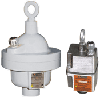
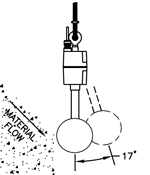 TC-3 - Monitor’s model TC-3 is a light-duty tilt switch
constructed from cast aluminum. It is ideally suited
for applications where relatively light weight, moderately
sized materials are handled (i.e. 15-60lb/ft³ ; 240-960kg/m³
or particle sizes less than 2in; 50mm). Typical application
materials include feed, plastic pellets and pet food. (Extension actuators are optional. See Optional Accessories Section.) TC-3 - Monitor’s model TC-3 is a light-duty tilt switch
constructed from cast aluminum. It is ideally suited
for applications where relatively light weight, moderately
sized materials are handled (i.e. 15-60lb/ft³ ; 240-960kg/m³
or particle sizes less than 2in; 50mm). Typical application
materials include feed, plastic pellets and pet food. (Extension actuators are optional. See Optional Accessories Section.)
|
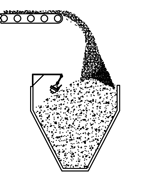 TC-1 - Monitor’s model TC-1 is a heavy-duty, weather-proof
tilt switch constructed from cast iron. It is ideally
suited for applications where heavy coarse materials
are handled (i.e. >45lb/ft³ ; >720kg/m³ or
particle sizes exceeding 2in; 50mm). Typical application
materials include coal, ore, rock, aggregate, and sand. TC-1 - Monitor’s model TC-1 is a heavy-duty, weather-proof
tilt switch constructed from cast iron. It is ideally
suited for applications where heavy coarse materials
are handled (i.e. >45lb/ft³ ; >720kg/m³ or
particle sizes exceeding 2in; 50mm). Typical application
materials include coal, ore, rock, aggregate, and sand.
|
|
|
Optional
Accessories (TC-3) |
|
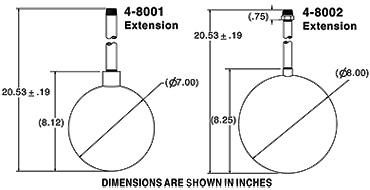
#4-8001 Extension actuator for TC-3, 20” overall extension length, stainless steel extension and 7” diameter ball float (assembly required; does not include TC-3)
#4-8002 Extension actuator for TC-3, 20” overall extension length, 8” dia. polypropylene ball float with galvanized steel extension(assembly required; does not include TC-3)
|
|
Specifications |
|
Model
TC-3: |
Power
Requirements: |
None |
Output: |
SPDT,
10A @ 250 VAC max |
Sensitivity: |
17° from
vertical axis |
Enclosure: |
cast
aluminum, unpainted |
Enclosure
Protection: |
NEMA
4, IP56 |
Mounting
Connection: |
Eyebolt,
3/4" (19mm) I.D. |
Wire
Entry: |
3/8" NPT
cord connector, cord diameter 0.25 to 0.38in
(6.4 to 9.6mm) |
Op.
Temp.: |
-40° to
175°F (-40° to 79° C) |
Weight: |
3
lbs. (1.35 kg) |
Approvals: |
CE marking (Ordinary
Locations Only) |
Model TC-1: |
Power Requirements: |
None |
Output: |
SPDT, 15A @ 250 VAC max |
Sensitivity: |
17° from vertical axis |
Enclosure: |
cast iron, painted beige |
Enclosure Protection: |
NEMA 4, IP56 |
Mounting Connection: |
Eyebolt, 1-3/32" (27.7mm) I.D. |
Wire Entry: |
1/2" NPT cord connector, cord diameter
0.25 to 0.38in (6.4 to 9.6mm) |
Op. Temp.: |
-40° to 250°F (-40° to 121° C) |
Weight: |
24 lbs. (11.25 kg) |
Approvals: |
CE Marking |
|
|
|
Warranty |
|
Monitor
Technologies warrants each tilt switch it manufactures to
be free from defects in material and workmanship under normal
use and service within two (2) years from the date of purchase.
The purchaser must notify Monitor of any defects within
the warranty period, return the product intact, and prepay
transportation charges. The obligation of Monitor Technologies
LLC under this warranty is limited to repair or replacement
at its factory. This warranty does not apply to any product
which is repaired or altered outside of Monitor Technologies'
factory, or which has been subject to misuse, negligence,
accident, incorrect wiring by others, or improper installation.
|
|
Part Numbers / Product Configurations |
|
Part
# > Product Configuration
4-3103 > TC-1 tilt switch, standard unit with heavy duty cast iron housing
4-8131 > TC-3 tilt switch, medium duty, cast aluminum housing |
|
Last Rev. March 16, 2015
|
|
|
|
|
 |
|
 |
|
QuantiMassTM
Mass Flow Measurement Systems |
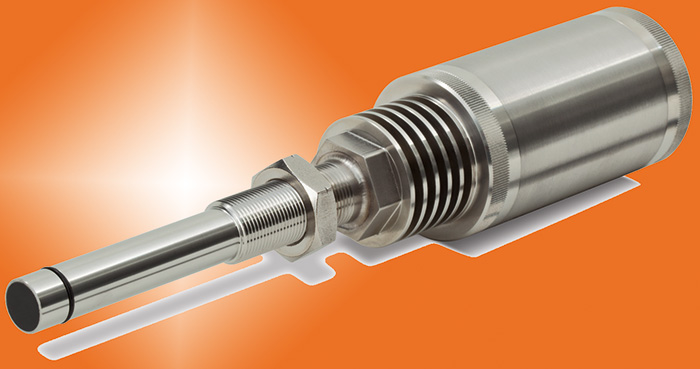
The QuantiMass in-line mass flow sensor measures the flow of quantities in pneumatic conveying & free-falling processes. The sensor is based on the latest Microwave Doppler Effect technology and provides fast, in-line / on-line measuring without the use of weight scales.
The sturdy, non-intrusive design of the sensor minimizes maintenance. In addition, the compact size of the sensor makes for easy installation into existing processes. Suitable for powders, dust, pellets, and granular up to 0.75 inch (2cm).
Versions:
Ultra Series-Includes controller
PRO Series-Includes transmitter
A practical application for the QuantiMass would be to monitor material flow rates to verify blending mixture ratios.
Principle of Operation:
The QuantiMass Mass Flow Measurement Sensor / Meter is designed with the latest microwave technology and is used to continuously quantify the flow of powders & solids being conveyed in metallic pipes. The QuantiMass is based on technology that has been developed and proven over several years. The measurement process of the sensor is centered on the Doppler effect. The mass flow-rate is determined by evaluating the frequency and amplitude changes during the measurement process. Particles at rest, such as deposits, do not influence the measurement. All powders, dust, pellets and granules can be measured reproducibly, up to the size of 0.75 inch (2cm). The QuantiMass sensor is suitable for continuous in-line / on-line measurements in pneumatic conveying or in free-fall pipelines.
Click
here for more information on the QuantiMass
or
contact Monitor Technologies LLC at
Tel.: 800-601-6319 in the USA and
Tel.: 630-365-9403
worldwide.
|
 |
|
|
|
|
|
|
|
 |
|
 |
 |
|







 CLICK HERE TO SEND
PAGE TO A FRIEND
CLICK HERE TO SEND
PAGE TO A FRIEND