Houston, TX – In the October meeting of the Houston Material Handling Society, Joe Lewis of Monitor Technologies LLC spoke about “Recent Directions in Level Monitoring & Measurement for Bulk Solids” and reminded the group of approximately 40 area engineers, representing nearly 1,000 years of material handling expertise, that while their companies may see them simply as a cost of doing business, they must take the initiative to show their employers that they indeed drive business performance improvements through process optimization. Quoting from a recent editorial in a key automation magazine Mr. Lewis said that “engineers must step up and assume a leadership role within their companies by helping drive new levels of business performance”. He further stated that the reason many companies don’t understand the true value of engineering is “because most financial systems cannot measure the improvements you generate”.
In the talk that Mr. Lewis presented to the HMHS group of engineers he discussed two directions in level measurement and monitoring of bulk solids where engineers can demonstrate the type of value they bring to their employers. These include the use of “self-validating bin level monitors” to prevent silo spills due to unknown high level indicator failures, and tips to ensure successful use and installation the most popular continuous level measurement technology for bulk solids, the guided wave radar level sensor. For more information please download the Word document and PowerPoint presentation from Mr. Lewis’s Level Measurement blog post at www.monitortech.typepad.com or contact Mr. Lewis at jlewis@monitortech.com or 1-800-766-6486.
Spotlight: RF Capacitance Level Sensor
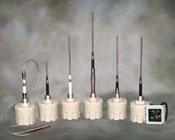
TrueCap® MK-2
Advanced RF Capacitance Level Probe
The TrueCap® Model MK-2
RF Capacitance point level probe is designed to provide a superior
and stable sensitivity threshold making it suitable for a variety
of powder / bulk solids and some liquid or slurry applications.
Advanced features of the Model MK-2 include: > Automatic immunity to material build-up on
the probe by its driven shield design > Push-button calibration > Enhanced temperature compensation > Maximized reliability via smart sensing algorithms
like “self-validating” fail-safe protection > Visible status LED on ordinary location units > Versatility through a variety of configuration
options including: hazardous location version, split architecture
design, quick-connect process connection, stub probe, cable extensions,
solid extensions, Nylon® probes, Ryton® - equiv. probes,
etc.
A practical application for the TrueCap would be to use this level sensor where
a residual material build-up on a different sensor would cause a false material
level indication.
Principle of Operation for the TrueCap RF Capacitance Level
Probe:
The vessel wall and the active probe element establish an impedance reference
between each other when exposed to air which has a dielectric constant of 1.
When materials with a dielectric constant greater than 1 are in close proximity
to the probe, the impedance of the sensing field between the sensor and the vessel
wall will change. Once the amount of change exceeds a threshold that was electronically
determined during the calibration process, an output relay will either be energized
or de-energized depending upon the position of the fail-safe selector on the
probe’s electronic circuit board. A change of as little as .5 pico-farad
is all that is necessary for the probe to sense the presence of material.