Cable-Based Sensor System Improves
Silo Level Accuracy
Monitor Technologies LLC announces
that a leading charcoal manufacturer has used its latest
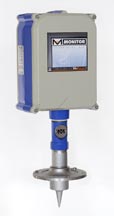
second edition SiloPatrol® SE inventory monitoring
system to improve the accuracy and ease of making silo
level measurements of charcoal.
“We used a cable running up the side of the silo through the top and down
inside with a weight attached to the end inside the silo. The end on the outside
was attached to a hand winch. We would release the winch, lower the cable
until it appeared it had hit the material surface. Then we would take a
reading from a marker on the cable on the outside.”, says the charcoal
manufacturer. The problem that was created was measurement error and inconsistency
due to the manual method employed and human error in making this manual measurement. It
was very frequent that they were way off in readings and the measurement of the
cable outside the silo was always an “eyeball guess”. This
method was used on measuring wood chip and wood flour levels.
The solution was the SiloPatrol® SE inventory monitoring system from Monitor
Technologies. The SiloPatrol SE uses patent pending state-of-the-art technology
and incorporates leading reliable design techniques in electronics, software
and mechanics to make reliable inventory measurement in virtually any environment. This
state-of-the-art weight & cable system is a proven problem solver. Wood
chips have a bulk density of about 20-30 lbs/ft3 and wood flour is even lighter
at about 15-20 lbs/ft3. In addition, the dielectric constant was very low,
running around 1.7 or lower, making this material very difficult for sonar, radar
and other types of level measurement technologies.
Monitor Technologies LLC is a leading supplier of level, flow, particle emission
and aeration instrumentation for the worldwide powder and bulk solids market.
The experience and market knowledge gained over five decades has earned Monitor
a reputation for providing high quality and reliable product solutions. Monitor
is located in Elburn Illinois, give us a call today and let us put our creative
solutions to work for you!
For more information refer to www.monitortech.com or contact Ms. Emily
Jones at 1-800-766-6486 (630-365-9403).
The TrueCap® Model MK-2
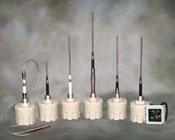
RF Capacitance point level probe is designed to provide a superior
and stable sensitivity threshold making it suitable for a variety
of powder / bulk solids and some liquid or slurry applications.
Advanced features of the Model MK-2 include: > Automatic immunity to material build-up on
the probe by its driven shield design > Push-button calibration > Enhanced temperature compensation > Maximized reliability via smart sensing algorithms
like “self-validating” fail-safe protection > Visible status LED on ordinary location units > Versatility through a variety of configuration
options including: hazardous location version, split architecture
design, quick-connect process connection, stub probe, cable extensions,
solid extensions, Nylon® probes, Ryton® - equiv. probes,
etc.
A practical application for the TrueCap would be to use this level sensor where
a residual material build-up on a different sensor would cause a false material
level indication.
Principle of Operation for the TrueCap RF Capacitance Level
Probe:
The vessel wall and the active probe element establish an impedance reference
between each other when exposed to air which has a dielectric constant of 1.
When materials with a dielectric constant greater than 1 are in close proximity
to the probe, the impedance of the sensing field between the sensor and the vessel
wall will change. Once the amount of change exceeds a threshold that was electronically
determined during the calibration process, an output relay will either be energized
or de-energized depending upon the position of the fail-safe selector on the
probe’s electronic circuit board. A change of as little as .5 pico-farad
is all that is necessary for the probe to sense the presence of material.